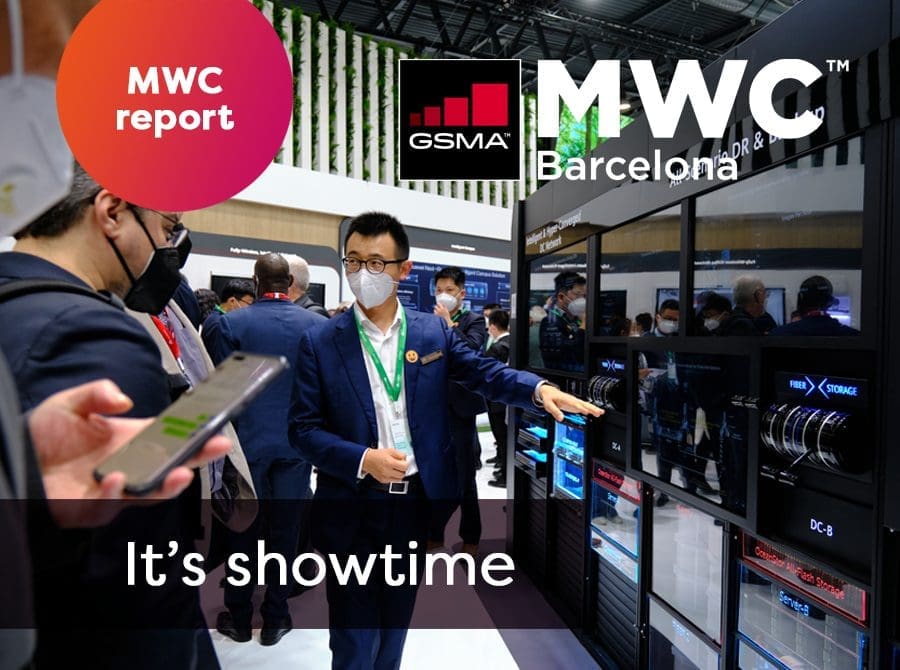
Now that the dust has settled on MWC2022, Real Wireless CTO Simon Fletcher reflects on the mood, the highlights and a few conspicuous absences.
It’s been quite a while since I’ve returned from MWC having thoroughly enjoyed the experience.
With many individuals and companies still not travelling, MWC2022 was, predictably, significantly quieter than usual. And while GSMA will be keen to build it back up to pre-Covid levels, the consensus on the frontline was that it worked better like this. It didn’t feel sparse, but there was less fighting to move around, less time wasted in coffee queues, and scheduled meetings happened as planned – a first for me at MWC.
So maybe the lesson for GSMA is to forget about becoming the world’s biggest tech show and just focus on making it the best.
Open RAN sound and fury
Thankfully, most firms weren’t being overly bullish this year which meant that, generally, the hype was spread more thinly than usual.
Open RAN was clearly much in evidence. On the downside, there was too much unhelpful bickering between the various Open RAN camps, which does nothing to further industry alignment or customer confidence. What we need is more interoperability, less discord, and more demonstrable market progress.
On the positive side, there were pockets of tangible traction in evidence, with companies demonstrating ASICs for Open RAN DUs and RUs. This is Holy Grail territory because getting the supply of components in this area right has the potential to deliver massive MIMO capabilities without tier one vendor lock-in.
It was also promising to see that the steps needed to drive costs down and adoption up were being taken, with end-to-end processing of DU components for the radio (MAC/PHY); and promising signs that silicon is on its way and being tested – with OEM partnerships using those chips in labs. There was also much talk from the likes of Mavenir and Juniper/Parallel about how their renditions of RIC (RAN intelligent controllers) could bring the full potential of Open RAN to the world.
In other words, it felt like there was genuine movement on the Open RAN front, albeit accompanied by an unacknowledged danger that if baby steps didn’t soon turn to strides, everyone might lose interest. The next year or so is probably crunch time.
What was missing?
While vendors mostly demonstrated a refreshing dose of pragmatism, I felt there were three main areas that deserved more visibility.
As an independent assessor for the UK’s Shared Rural Network Initiative, Real Wireless puts a lot into ensuring rural communities and remote locations are not disenfranchised on the connectivity front. The conference agenda paid lip service to the subject, as it has done since ‘connecting the unconnected’ became part of GSMA’s mission statement, but across the show nothing much seems to have moved on. This might be a reflection of the times. Although rural connectivity is still a significant issue in many developed markets, the industry persists in viewing it as a developing markets issue. Given that pandemic fallout meant that the number of delegates from developing markets were well down on previous years, maybe someone made the decision to put rural on the back burner (again) this year?
If they did, it was a mistake.
Rural connectivity remains high on the agenda of governments and policy makers in developed and developing markets and the industry needs to keep it in focus to avoid the dead hand of punitive coverage regulation.
Multi-operator infrastructure is one way of addressing the costs of rural coverage head on and, moving on to absent theme two, I was surprised there wasn’t more focus on the conference agenda that reflected the very significant shifts we’re seeing on the service provider front. MWC is still very much an MNO show and doesn’t yet seem to have found a way of drawing neutral hosts into the fold. I think this is because although it has always been good at showcasing the new, the visionary and the blue-sky from a technology perspective, organisers seem less attuned to evolving business models.
The third conspicuous absence relates to private networks. Most of the pre-show trends-to-watch-out-for pieces suggested that this was going to be a hot topic at the show. I came away feeling that it was and it wasn’t. There was certainly a good deal of largely DAS and small cell kit pitched at the PCN market but in terms of show themes that’s as far as it went. Enterprise, private networks, same thing, move on. But key issues relating to scaling private network deployments, avoiding fragmentation, the commercial implications of 5G standalone and service delivery to specific verticals, none of this seemed up for discussion.
Once again, it could be that this is more an issue for integrators, specialist providers and neutral hosts and of less interest to the MNO community. But it felt like a curious absence.
This said, behind the usual layers of security, hyperscalers like AWS certainly had private networks in their sights, promising to do away with much of OSS/BSS complexity and in the process lower costs. In addition, both Cisco and HPE showcased private 5G solutions boasting interworking across both private 5G and Wi-Fi networks.
Finally, away from the various industrial tracks the show seems to have attracted fewer participants from verticals than previous years. Again, this is probably down to pandemic fallout and prioritising
more targeted events, but this is something the organisers will need to work on going forward. Our industry never gets very far when limited to talking to itself.
More present
Cloudification has continued to back into the limelight, not just through behemoths like AWS, but in the way in which advances and innovation in MANO has suddenly become urgent again. As networks and services become more flexible, and architectures and the nature of service provision more varied, zero touch automation becomes increasingly important. Tier one vendors have tended to run with the proprietary management systems that work with their own equipment. This means that the innovation is largely associated with smaller specialist players that are in turn often associated with additional cost by most service providers. Talk around the show was that this is something that needs to change.
While the verticals were thin on the ground the opposite was true of governments, national trade stands and policy makers. The UK and Japan announcing collaboration was one positive output at the show – and demonstrates how seriously regulators and governments are taking both their digital transformation agendas and MWC as a place to connect with businesses and influencers that can help turn visions into deployments.
And finally…
I decided quite early on that the delegates fell into two main camps. Those that wanted to talk about metaverse and 6G all the time and those that didn’t want to talk about either at all. Fortunately, the majority fell into the latter category. NGMN put out a stake-in-the-ground 6G paper which sets out key use case areas and seems likely to be trotted out for the next several years in the manner of the 5G use case pyramid. It feels like the technical and business case challenges around standalone 5G, the rapid evolution of network architectures and undercurrents of fragmentation on multiple fronts blunted most delegates enthusiasm for getting overly involved in the 6G debate, despite the European Commission’s support of the subject in the course of the show. We can be fairly sure it will be up for discussion again at MWC2023.
Oh… and I missed the TIP/Meta/Telefonica session on how the industry needs to start developing metaverse-ready networks. I’m sure we’ll also be able to catch that again next year.