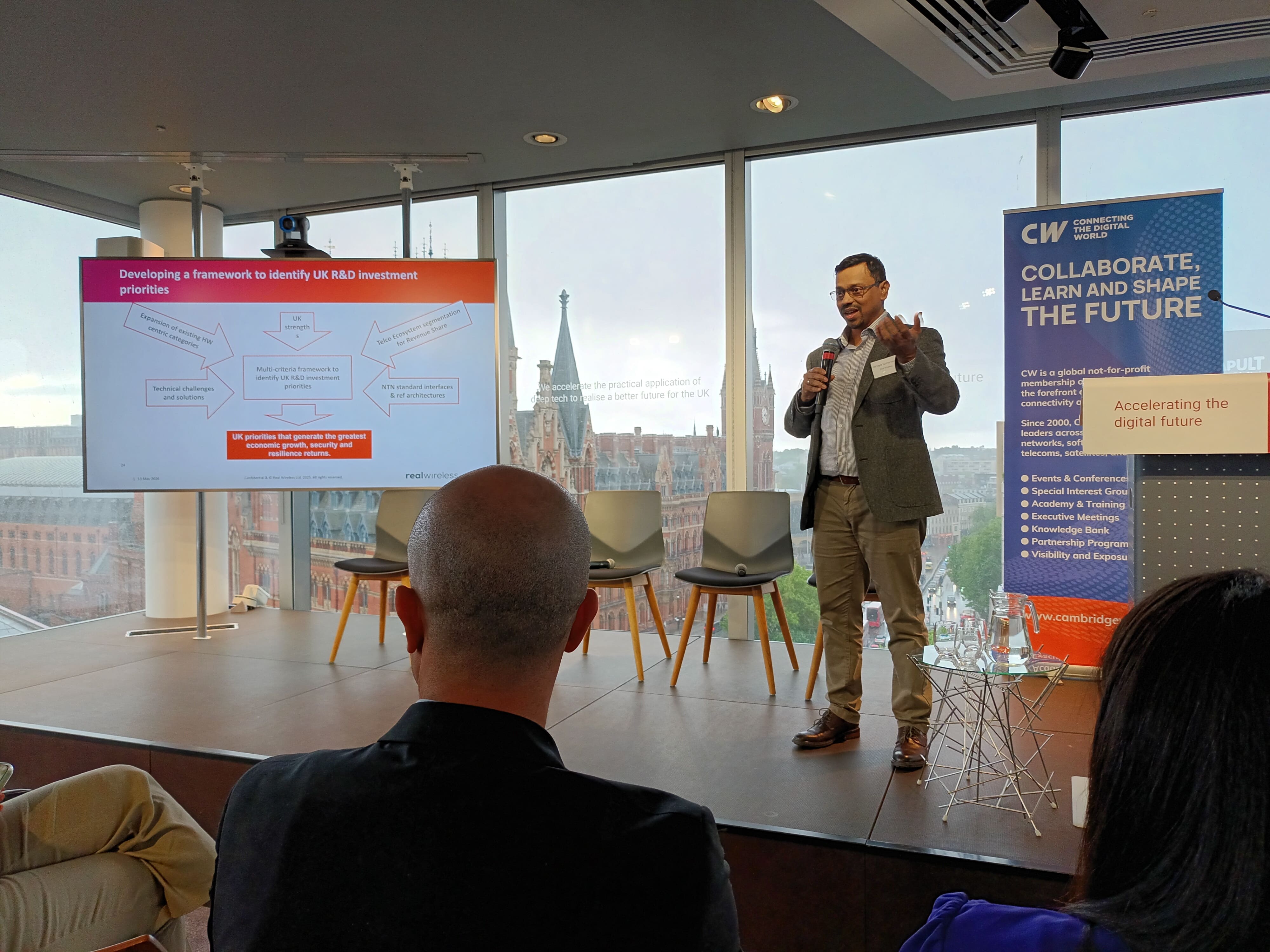
At the Cambridge Wireless ‘NTN Show Me the Money’ Event held at Digital Catapult in early May 2026, Dr. Abhaya Sumanasena presented a strategic framework aimed at identifying where UK research and development investment in satellite telecommunications could deliver the greatest long-term economic value.
Speaking as both the Head of Policy and Regulation at Real Wireless and the Chairman of the UKSPF, Dr Sumanasena outlined an approach that goes beyond traditional revenue-share analysis. Instead, the framework evaluates UK satellite telecoms R&D opportunities through a broader lens that includes growth potential, strategic leverage, competitiveness and sovereign resilience alongside overall market size.
A central theme of the presentation was the growing importance of software-led network functions and digital payload processing. Although these areas currently account for a relatively small share of sector revenues, they are expected to become critical enablers of the emerging Direct-to-Device (D2D) ecosystem.
The framework highlighted how open-standards-driven markets could provide UK companies with a strong competitive position, allowing them to innovate and scale without directly challenging entrenched industry incumbents. However, the success of these technologies will depend heavily on mobile network operators adopting satellite connectivity as a standard service layer within future communications infrastructure.
Dr. Sumanasena also emphasised the strategic importance of satellite payload processing and cybersecurity capabilities. Unlike some commercially driven technologies, these sectors were identified as offering significant benefits for sovereign resilience, regardless of the pace of commercial adoption.
Meanwhile, more mature hardware-focused segments of the satellite industry may require a different policy approach. The framework suggested that such categories could benefit from targeted or conditional government support mechanisms, rather than being prioritised solely on projected growth potential.
The discussion reflects a wider industry debate around how the UK can position itself competitively within the rapidly evolving non-terrestrial network (NTN) and satellite communications landscape, while balancing commercial opportunity with long-term national capability and resilience.