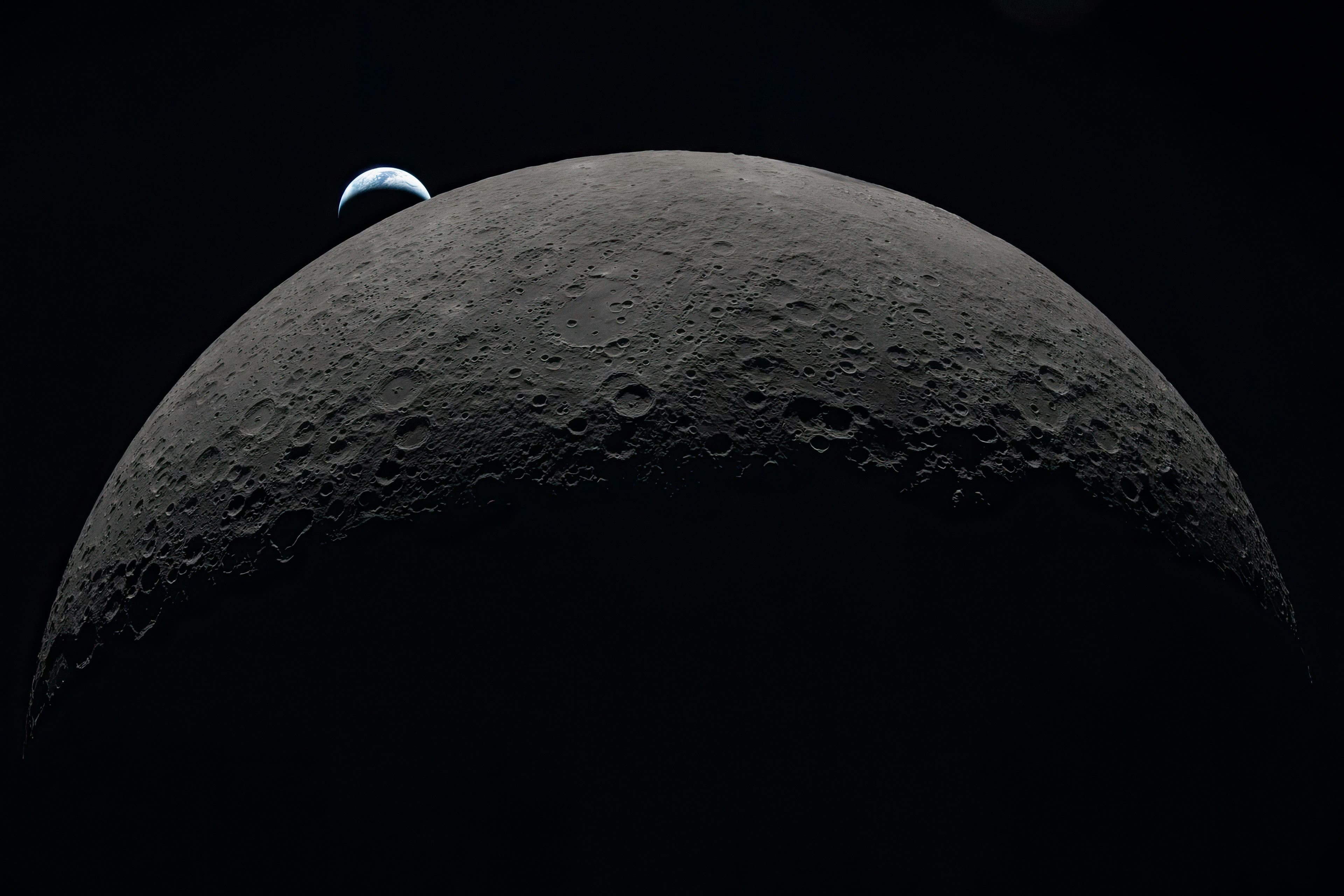
As nations and commercial organisations prepare for a new era of sustained lunar exploration, communications will become a fundamental enabler of activity on and around the Moon. Every crewed mission, robotic lander, scientific observatory and commercial service will rely on secure, reliable access to radio spectrum.
While the technology enabling these missions is advancing rapidly, the regulatory framework governing spectrum use beyond Earth is still evolving.
That is why Real Wireless was pleased to undertake the independent study, Spectrum Landscape for Lunar Communications, for the UK Spectrum Policy Forum (UK SPF). Published this month by TechUK, the report examines how spectrum requirements are likely to evolve over the coming decade and identifies the regulatory actions needed to ensure future lunar communications remain efficient, sustainable and free from harmful interference.
Commenting on the publication of the report, Dr Abhaya Sumanasena, Head of Policy and Regulation at Real Wireless, said:
Real Wireless was pleased to conduct this first-of-its-kind study examining the regulatory challenges associated with the emerging lunar communications landscape, and the leadership role the UK can play in shaping future regulatory frameworks.
With its long-standing strengths in communications, radio astronomy and space research, the UK is uniquely positioned to act as an honest broker, bringing together stakeholders and fostering international alignment on key regulatory principles. By helping to establish a common international baseline, the UK can support global collaboration and the sustainable development of lunar communications. The report sets out practical recommendations and clear next steps for UK policymakers, industry and international partners to advance this agenda.”
We are proud to have supported the UK Spectrum Policy Forum in delivering this important piece of research. As lunar communications move from concept to operational reality, robust, evidence-based spectrum policy will be just as critical as the technologies that enable it. We hope this study provides a valuable foundation for policymakers, industry and the international space community as they work together to shape the future of communications on and around the Moon.
The Moon is becoming a connected environment
For decades, lunar communications involved a relatively small number of government-led missions, with limited need for formal spectrum coordination.
That picture is changing rapidly.
Over the next decade, the lunar environment is expected to become home to permanent surface infrastructure, commercial landers, relay satellites, navigation systems, scientific observatories and crewed missions. Communications networks will no longer support isolated spacecraft but an increasingly complex ecosystem of operators working simultaneously.
Managing radio spectrum effectively will be fundamental to ensuring these diverse systems can coexist safely and reliably.
WRC-27 is a pivotal opportunity
One of the report’s key findings is that World Radiocommunication Conference 2027 (WRC-27) Agenda Item 1.15 represents the international community’s first formal opportunity to establish spectrum arrangements specifically for lunar communications.
The agenda item considers whether lunar Space Research Service (SRS) systems can share spectrum with terrestrial and Earth-orbiting services without causing harmful interference.
The technical evidence reviewed in the study is encouraging. Current ITU-R sharing studies indicate that coexistence is achievable across most candidate frequency bands, with comfortable interference margins in the majority of scenarios.
The report also identifies emerging trends in how different frequency bands are likely to be used:
- Ka-band is becoming the preferred band for medium and high-capacity communications.
- X-band will continue to provide resilient, safety-critical communications.
- S-band will increasingly support proximity operations.
- Optical communications are expected to carry growing volumes of high-capacity traffic, while radio will remain the dependable backbone for surface operations, mobility and contingency communications.
Protecting a unique radio environment
The study also highlights a significant challenge beyond communications performance.
The far side of the Moon is the quietest radio environment in the inner Solar System, making it uniquely valuable for highly sensitive low-frequency radio astronomy.
As more spacecraft and surface systems arrive, the greatest threat may not come from intentional transmissions but from unintended electromagnetic emissions generated by otherwise compliant equipment. The report concludes that existing protections within the ITU Radio Regulations provide an important starting point but require clearer technical guidance, agreed interference thresholds and practical verification methods if they are to remain effective as lunar activity expands.
Because spacecraft launched today may still be operating decades from now, decisions about protecting this environment cannot be deferred.
Building the regulatory framework for the future
Current spectrum coordination arrangements have served the space community well while lunar operations have remained relatively limited.
However, the report concludes that voluntary coordination alone is unlikely to scale to a future involving many commercial operators, multiple nations and permanent lunar infrastructure.
Among its recommendations, the study calls for:
- Supporting consensus spectrum allocations under WRC-27 Agenda Item 1.15.
- Strengthening protections for the lunar Shielded Zone.
- Developing practical coordination mechanisms based on exclusion zones, coordination arcs and time-sharing.
- Establishing stronger international coordination processes that include commercial operators.
- Continuing work beyond WRC-27 through the ITU-R and the Space Frequency Coordination Group (SFCG), supported by national licensing frameworks.
A role for UK leadership
The report concludes that the UK is well placed to help shape this evolving regulatory landscape.
Through programmes such as Lunar Pathfinder, expertise in satellite communications and a strong heritage in radio science, the UK has both the technical capability and international credibility to contribute meaningfully to the development of future lunar spectrum policy.
As the study makes clear, the decisions taken over the next few years will establish operating norms for the lunar environment long before any comprehensive international treaty exists. Developing those norms now will help ensure that future lunar communications support innovation, commercial growth and scientific discovery while protecting one of the most valuable radio environments beyond Earth.