


We’ve come a long way from the voice and text services that once made up the entire offering of mobile networks. Web browsing, emails, video calls, streaming and other IP-based services eventually followed. Then networks were turbocharged by smartphones and 4G-LTE technology. Now social media applications and advanced multimedia services are available on most phones in most places.
With 5G, capacity will grow and smarter data bearers with artificial intelligence will, over time, become embedded everywhere across the network. But if this evolved 5G connectivity proves transformational, how much more may we need a putative 6G to offer? Real-time gaming? Advanced use cases like the internet of senses? Convergence of cellular, Wi-Fi, fixed and satellite? New, wireless-led industries?
It won’t just be about humans either. There will be connected vehicles, smart manufacturing, AR/VR for Industry 4.0 and massive IoT, as well as high-quality video and real-time entertainment and games, and the metaverse, on the move. With all these different connectivity scenarios the requirements and the diversity of requirements for guarantees of ultra-low latency, reliable, faultless connection, and availability for every use case, everywhere at any time, is only growing.
For that reason, the journey that 5G performance management systems have been on will need to continue. Real-time requirements for data collection will increase, with end-to-end needs across a variety of interfaces and systems. Technologists are pushing for richly instrumented networks, with feedback telemetry, instant analysis, and intelligent correlation, to anticipate, detect, measure and avoid any potential failure.
We have seen service providers developing their approaches to the assessment of the quality of experience (QoE) in their networks for some time. As service providers seek to improve monetisation, we anticipate innovation in efforts to differentiate and win consumers with this aspect of their networks. So, we look to see a roadmap of QoE offerings and develop our capability to evaluate the claims.
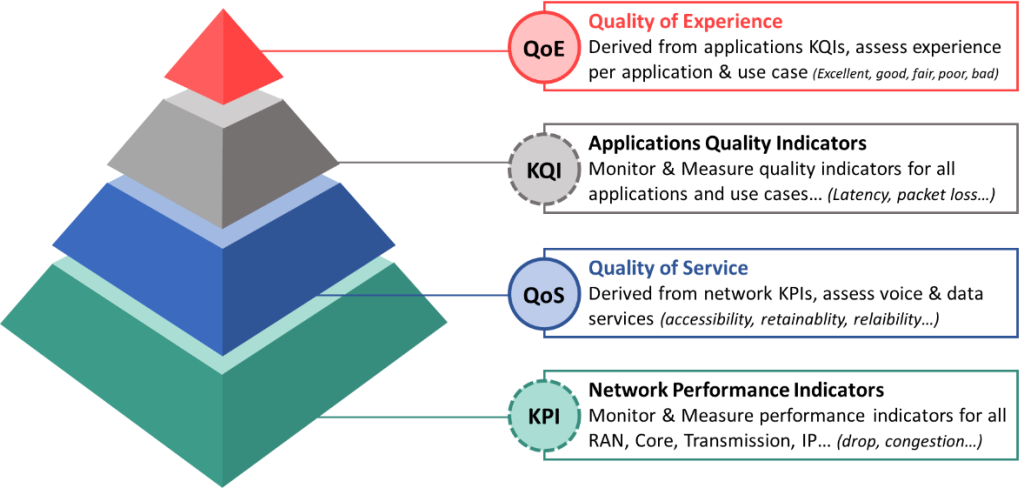
We expect to see successful performance management combining views of both the network underlay quality of service (QoS), and the applications/services overlay (QoE).
Accurate key performance indicator (KPI) measurements from the underlay network, combined with service-level quality metrics, should enable wireless service providers to deliver end-to-end QoE for their users. This will be particularly important for private networks and people using enterprise apps, growth areas that we feel 5G Advanced has some work to do to continue to refine and no doubt 6G researchers to seek to enhance supporting features of networks, devices, and applications.
All of which means more performance monitoring data. Network KPIs will need to measure performance across all entities, interfaces, systems and specific components related to MIMO, mmWave, O-RAN, and more. This will generate a massive amount of data – data that needs to be understood.
Operators will also need to understand the network topology and architecture, the specific configurations associated with the spectrum band, MIMO, bandwidth, uplink and downlink traffic paths, 4G-5G-6G interworking, core setup SA-NSA, O-RAN, backhaul, mid-haul, fronthaul, network slicing and MEC availability.
Without an in-depth understanding of the trade-offs at the network build stage, the quality of performance measurement setup for efficient QoS monitoring could be compromised as coverage and capacity will always influence QoE. Network dimensioning and proper planning of wireless infrastructure rollout are necessary to tune these aspects of networks which is why this area remains a challenge for operators.
And we can help. We include in our offering the wireless infrastructure planning and deep analysis essential to establish an acceptable QoE for end users that may be using a variety of applications where the user acceptance and willingness to pay will be informed by this aspect.
Quality assurance in the 5G and 6G future will be challenging it will mean combined QoS/QoE measurements that are correlated together in the context of potentially completely automated and optimised network management to manage complexity and secure high-level end-user experience. Sophisticated models and tools will be needed to make this happen.
We engage with QoE research expertise to understand the feasibility of claimed techniques, and importantly to gain an understanding of the business viability of such approaches. Approaches are already in place for 5G, and it is good to see the research and pre-standards communities tackling this topic as part of their 6G research. Our engagement in the UK (REASON) and EU (TrialsNet) 6G Research and Innovation projects enables us to refine our independent evaluation techniques for this aspect of wireless network performance, not only for 5G Advanced but also for shaping requirements for 6G.